
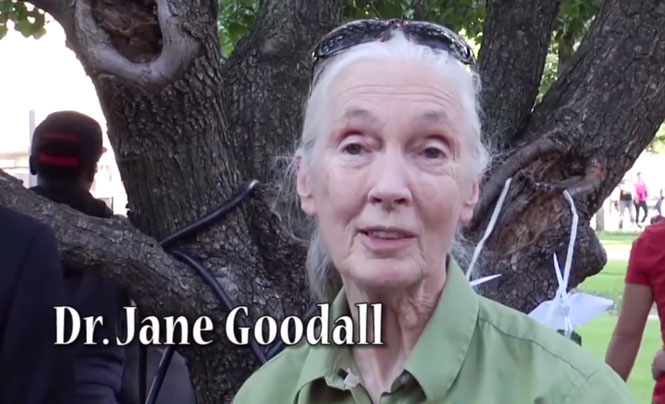
Her discoveries in the 1960s about how chimpanzees behaved in the wild broke new ground and represented what was called “one of the Western world’s great scientific achievements.”
Jane Goodall, one of the world’s most revered conservationists, who earned scientific stature and global celebrity by chronicling the distinctive behavior of wild chimpanzees in East Africa — primates that made and used tools, ate meat, held rain dances and engaged in organized warfare — died on Wednesday in Los Angeles. She was 91.
Her death, while on a speaking tour, was confirmed by the Jane Goodall Institute, whose U.S. headquarters are in Washington, D.C.
The British-born Dr. Goodall was 29 in the summer of 1963 when the National Geographic Society, which was financially supporting her field studies in the Gombe Stream Chimpanzee Reserve in what is now Tanzania, published her 7,500-word, 37-page account of the lives of Flo, David Greybeard, Fifi and other members of the troop of primates she had observed.
The article, with photographs by Hugo van Lawick, a Dutch wildlife photographer whom she later married, also described her struggles to overcome disease, predators and frustration as she tried to get close to the chimps, working from a primitive research station along the eastern shore of Lake Tanganyika.
On the scientific merits alone, Dr. Goodall’s discoveries about how wild chimpanzees raised their young, established leadership, socialized and communicated broke new ground and attracted immense attention and respect among researchers. Stephen Jay Gould, the evolutionary biologist and science historian, said her work with chimpanzees “represents one of the Western world’s great scientific achievements.”
And in becoming one of the most famous scientists of the 20th century, Dr. Goodall opened the door for more women in her largely male field as well as across all of science. Women — including Dian Fossey, Biruté Galdikas, Cheryl Knott and Penny Patterson — came to dominate the field of primate behavior research.
On learning of Dr. Goodall’s documented evidence that humans were not the only creatures capable of making and using tools, Louis Leakey, the paleoanthropologist and Dr. Goodall’s mentor, famously remarked, “Now we must redefine ‘tool,’ redefine ‘man,’ or accept chimpanzees as humans.”
#DrJaneGoodall #JaneGoodall

 Times Square International Day of Peace and NYC Climate Week Concert AY Young, Battery Tour Part 3