
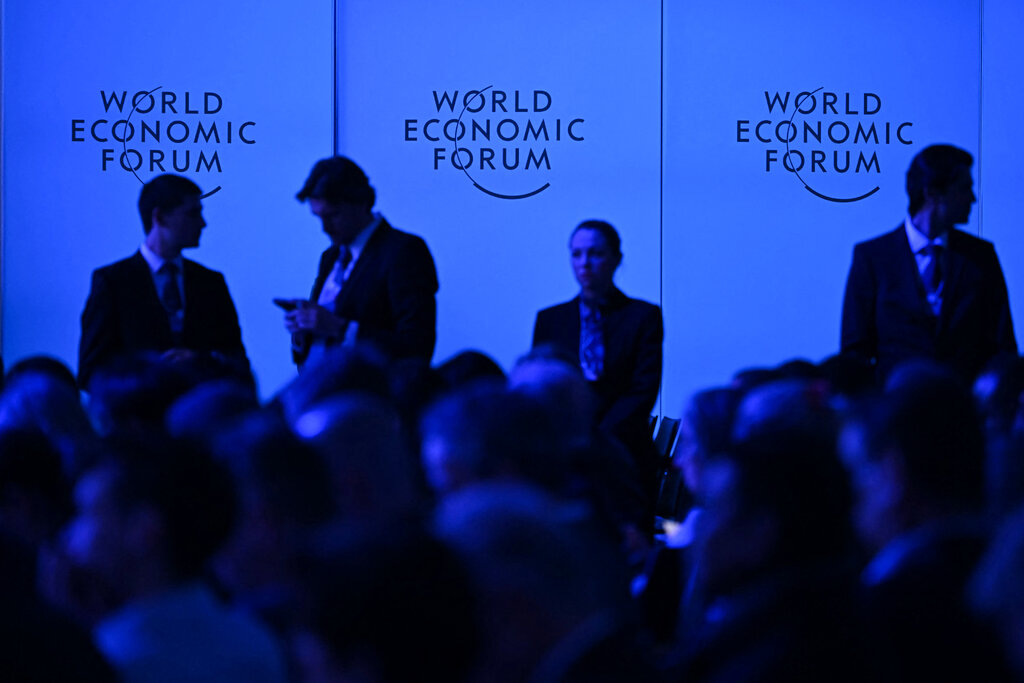
At the Davos forum in recent years, the focus on climate change and stopping biodiversity loss has taken a back seat to issues like cryptocurrency, artificial intelligence and geopolitics. Fabrice Coffrini/Agence France-Presse — Getty Images
Dire warnings at Davos, pushed to the periphery
 |
By David Gelles |
All week at the World Economic Forum’s annual gathering in Davos, Switzerland, talk about climate change and renewable power has been relegated to the sidelines.
That changed on Wednesday, when President Trump used his speech at this gathering of the world’s top business leaders and policymakers to attack clean energy.
“There are windmills all over Europe,” he said. “There are windmills all over the place and they are losers.”
That was just one snippet from a speech in which Trump assailed the “green new scam,” promoted fossil fuels and made inaccurate statements about China’s use of coal.
Trump’s assault on renewable energy struck a discordant note at an event that was once a center for the corporate climate movement. But since Trump’s re-election Davos has strained to retain an idealistic, optimistic spirit.
For years, Davos was where chief executives and heads of state came to make high-minded pledges about how they would use their power to transform the world for the better and reduce dangerous planet-warming emissions.
Recently, however, the focus on climate change and stopping biodiversity loss has taken a back seat to issues like cryptocurrency, artificial intelligence and geopolitics. Instead, talk about sustainability efforts and climate action is now largely relegated to the scientists and activists.
Jennifer Morris, chief executive of The Nature Conservancy, told me that the dialogue in Davos had some glaring blind spots. “We’re not talking enough about oceans here,” she said, citing one example.
“Water is not woke,” she added.
Corporations are suddenly silent
The explanation for Davos’s pivot is simple. Climate change is no longer center stage in Davos because, in large measure, corporations have gone quiet on the issue.
“The Davos programming is a reflection of what chief executives want to talk about, ultimately,” said Sebastian Buckup, who runs the World Economic Forum’s center for nature and climate.
And what C.E.O.s want to talk about has changed.
Six years ago, Larry Fink, the chief executive of BlackRock, the world’s largest asset manager, used his time in Davos to rally Wall Street to combat climate change, promising to “transform finance.”
In an article I published last week, I explained how Fink sparked a movement that came to encompass most of the major banks, asset managers and asset owners in the world, which pledged to used their trillions of dollars to try and blunt global warming.
But in the face of pushback from Republicans, the fallout from the war in Ukraine and the return of President Trump to the White House, Wall Street has largely abandoned its climate pledges. Many of the alliances designed to make finance more sustainable have fallen apart. Investors have withdrawn tens of billions of dollars each quarter from E.S.G. funds.
Even though Fink is now co-chair of the World Economic Forum and took a strong hand in shaping this year’s program, which features hundreds of panels and speakers scattered across giant convention halls and small meeting rooms, discussion of climate change was largely missing from the most prominent programs — with the exception of Trump’s remarks.
Warnings from scientists
On the rare occasions when there was frank talk about the dangers posed by our rapidly warming world, the warnings were more stark than ever.
Johan Rockström, director of the Potsdam Institute for Climate Impact Research, delivered a presentation on Tuesday in which he showed dozens of ways in which the planet’s natural systems are under severe strain.
“The human pressure on the planet has now reached a crisis point,” he said. “The era where we can continue with economic growth without putting the stability of planet at risk has come to an end.”
Rockström added that “these pressures on the planet are now at risk of causing irreversible, potentially catastrophic tipping points.”
On Wednesday, I moderated a panel about why it was in companies’ own interest to protect nature.
“If you don’t have good land and good soil, you can’t have sustainable supply chains,” Kirsten Schuijt, director general of WWF International told me.
Schuijt said that more corporations were working to address these threats, but not fast enough. “It’s moving way too slow, because we’re losing biodiversity in basically every place we care about,” she said.
Then on Thursday, I hosted a discussion about how much economic activity was tied to the oceans, which are warming rapidly regardless of whether you think talking about it is “woke.”
For much of the conversation, the speakers put forward a rosy vision of continued economic growth that somehow didn’t pollute the planet. Then, during a remarkably candid moment, an executive acknowledged a notion that until recently had been gospel at Davos.
“The biggest adversary to nature might be humans,” said Boudewijn Siemons, chief executive of the Port of Rotterdam, the largest harbor in Europe. “The problem is us.”

 GoodNewsLetter: SNOW!! R2D2 first Robot? ET Phone Home CES, and Earth & Water Day April 22, 2026