
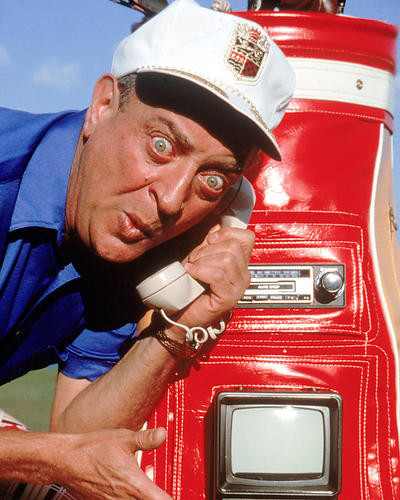
In 1962, Rodney Dangerfield was 40, deep in debt, separated from his wife, and living in a cheap New York hotel. He had already quit comedy once. With almost nothing going right, he decided to try again.
Born Jacob Cohen on November 22, 1921, in Babylon, New York, Rodney knew rejection long before audiences laughed about it. His father, vaudeville performer Phil Roy, was mostly absent. Money was scarce. Rodney later wrote that he was sexually abused at five, and school brought humiliation from teachers and classmates. “It affects everyone differently. I could have come out being a nicer person, or I could have come out being a nasty person.”
He started writing jokes as a teenager and was performing in clubs before he was 20, using the name Jack Roy. The money was miserable. Between comedy jobs he drove delivery trucks, worked as a singing waiter, and grabbed whatever paid. For years, the room might laugh and the rent still might not get covered.
At 28, he gave it up. Rodney married singer Joyce Indig in 1951 and tried to build an ordinary life in New Jersey. Their children, Brian and Melanie, came along, and the comedian became an aluminum siding salesman. He kept a notebook of jokes, but the stage was gone. The marriage struggled too, and by 1962 he was back in New York with debts pressing on him.
That was the moment he chose the ridiculous option. Start over at 40. He later remembered exactly how bad it looked. “I was broke. I owed $40,000. I lived in a dungeon hotel in New York. Everyone said I was finished.”
He returned to clubs under the name Rodney Dangerfield and slowly found the character that finally fit him. Tight collar. Red tie. Eyes that looked permanently worried. A man whose wife disliked him, whose doctor insulted him, whose neighbors robbed him, and whose childhood seemed like one long rejection.
His first appearance on “The Ed Sullivan Show” (1948–1971) came on March 5, 1967. More appearances followed, and the “no respect” idea began taking over his act. Jack Benny saw why it worked. “Rodney, I’m cheap and I’m 39, that’s my image, but your ‘no respect’ thing, that’s into the soul of everybody.”
The strange part was that success came when Rodney was already middle-aged. He opened Dangerfield’s comedy club in Manhattan in 1969, then helped give younger comics a place to work and, later, television exposure. Jerry Seinfeld, Jim Carrey, Roseanne Barr, Sam Kinison, and Bob Saget were among the comedians whose early careers crossed his orbit.
Then Hollywood finally caught up. In “Caddyshack” (1980), his loud, rich Al Czervik barged into scenes beside Chevy Chase, Bill Murray, and Ted Knight. That same period brought another surprise. His comedy album “No Respect” won the Grammy for Best Comedy Album in 1981.
Rodney was 64 when “Back to School” (1986) made him a genuine leading man. As Thornton Melon, he played a wealthy businessman who enrolls in college beside his son. The movie earned more than $91 million domestically. A man who had once sold aluminum siding because comedy could not support his family was now carrying a major box-office hit.
He could still surprise people. In “Natural Born Killers” (1994), Rodney played a vicious father, stripping away the lovable loser audiences expected. Away from work, he married Joan Child in 1993 after a long relationship. She stayed beside him through serious health problems, including brain surgery in 2003 and heart valve replacement surgery in August 2004.
Complications followed the heart operation. Rodney suffered a small stroke, developed infections, and slipped into a coma. He briefly regained awareness, kissed Joan, squeezed her hand, and smiled at his doctors. On October 5, 2004, he died in Los Angeles at 82.
He spent half a lifetime getting no respect, then made millions laugh because of it.

 The GALA