
NEW YORK (RNS) — Adams’ legacy among faith communities is marked by an unprecedented partnership that brought congregations to the front lines of city governance in ways no modern mayor had before.
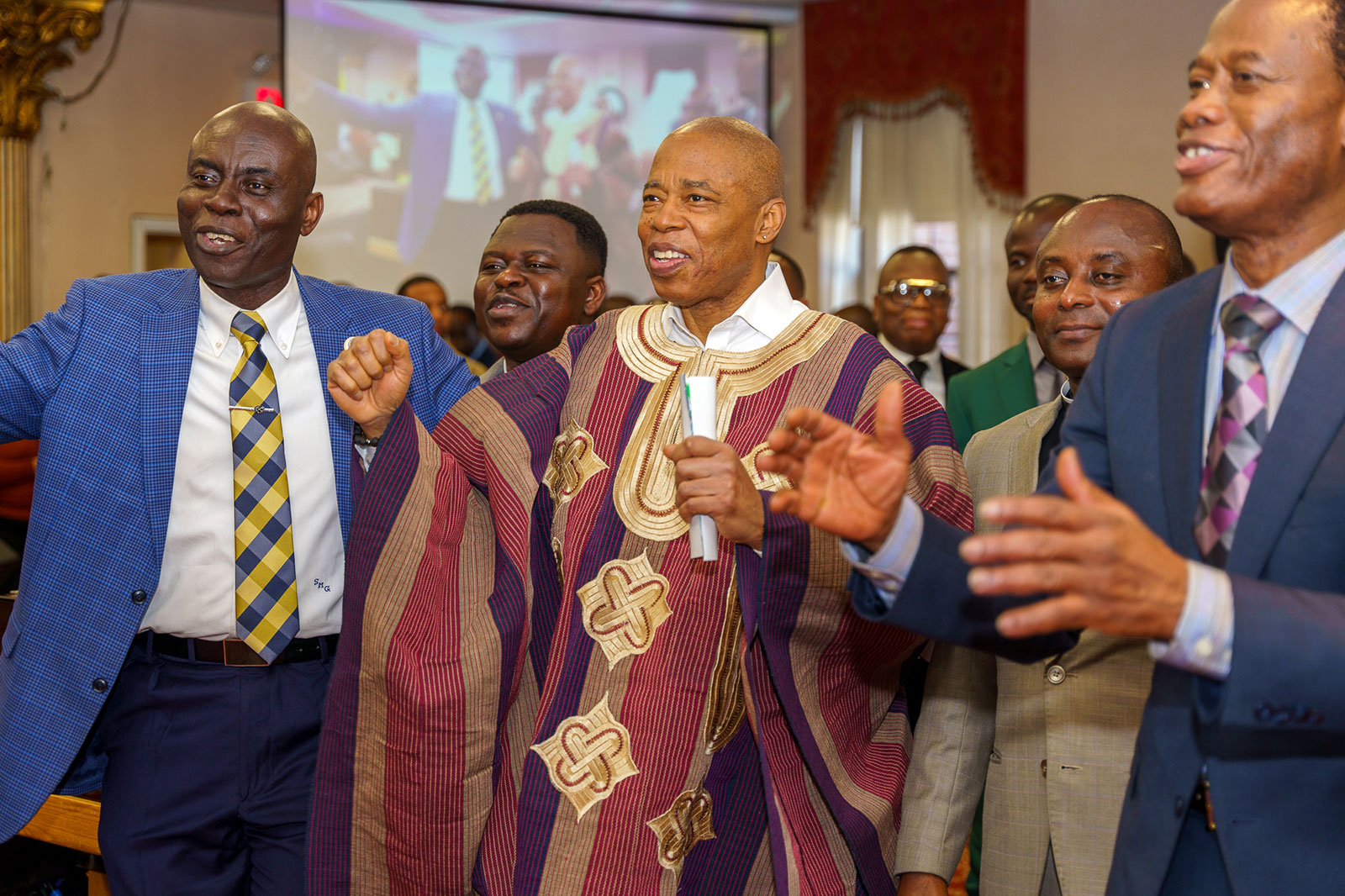
New York City Mayor Eric Adams, center, attends the Church of Pentecost USA Inc., Dec. 22, 2024, in the Bronx. (Photo courtesy of the Mayoral Photography Office)
By Fiona Murphy
October 7, 2025
NEW YORK (RNS) — As New York City Mayor Eric Adams prepares to leave office this fall, after suspending his reelection bid amid outcry over a scandal-ridden mayorship, he leaves behind a new network of faith leaders mobilized by his crisis initiatives and concerned those partnerships will falter under a new administration.
Adams, who was indicted in 2024 on federal charges of wire fraud, bribery and conspiracy tied to campaign fundraising, decided not to run in the Democratic primary in June, choosing to run in the general election as an independent candidate instead. But faced with the popular Democratic candidate, Zohran Mamdani, and the familiar face of former New York Gov. Andrew Cuomo, Adams announced on Sept. 28 that he would not seek reelection, after a Quinnipiac poll showed his approval rating was among the lowest for a New York City mayor in recent decades.
Despite his unpopularity with many New Yorkers, Adams’ legacy among faith communities is marked by an unprecedented partnership that brought small and often overlooked congregations to the front lines of city governance in ways no modern mayor had before.
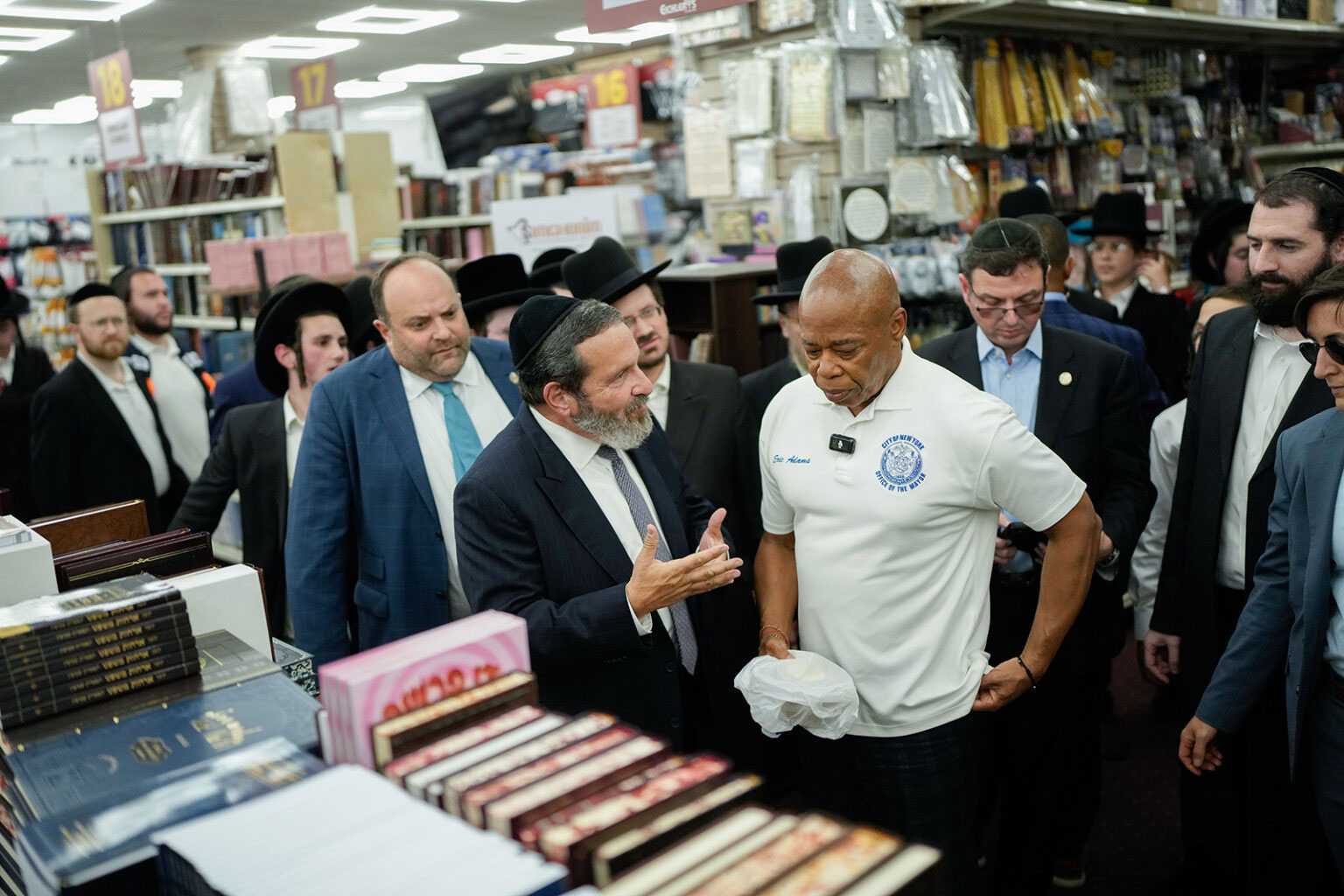
New York City Mayor Eric Adams, center right, meets with Jewish community leaders and walks through local businesses in Borough Park ahead of the upcoming Jewish High Holidays on Sept. 15, 2025. (Photo by Michael Appleton/Mayoral Photography Office)
“I think we were looking to make sure that the faith-based community had direct access to New York City resources,” Monrose said. “Adams wanted to make sure that the faith community is consistently on his radar, that he would be in touch with them, and our office would continue to maintain relationships.”
Monrose turned that mission into a sustained network of outreach. Through the OFBCP, members of different faith communities across New York’s five boroughs were invited to monthly meetings with city commissioners to discuss services such as food pantries, clothing drives and issues that affected their small congregations. Monrose manages a WhatsApp group with hundreds of contacts he’s gathered over his years as a pastor in Brooklyn, along with an email list that sends out announcements several times a week about upcoming events sponsored by his office.
“There are some rooms that I have been in that I would never have been in if it wasn’t for Eric Adams,” said Latricia Davis, the outreach ministry pastor at the Community Church of Christ in Jamaica, Queens. “The emails, the texts and the response from his office was unbelievable. I’m getting emotional about it because he cared about us.”
The office’s work evolved into citywide initiatives. In 2023, it launched the faith-based shelter program, mobilizing churches, mosques and synagogues to house asylum-seekers during the city’s migrant crisis by providing renovations and resources to congregations citywide.
“Mayor Adams was willing to work with congregations as a way of addressing social safety net needs in the city that has been so far unique,” said Peter Gudaitis, executive director of New York Disaster Interfaith Services, or NYDIS, a nonprofit that has provided disaster relief and faith-community recovery services that worked closely with the OFBCP to coordinate and activate the faith-based shelter program.
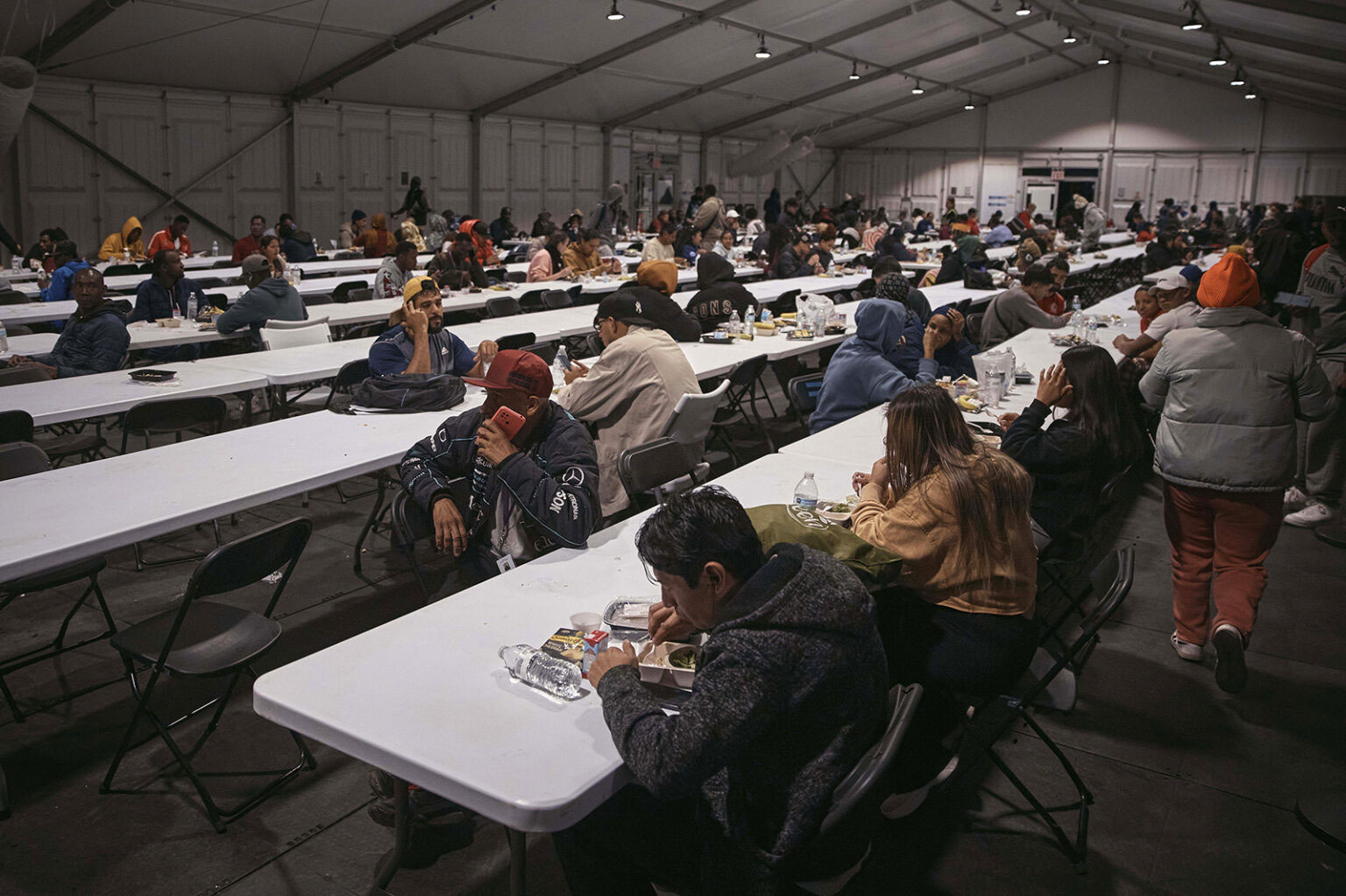
Muslims and non-Muslim migrants eat their meals together during an iftar, the sunset meal when Muslims break their fast in the holy month of Ramadan, at the migrant shelter on Randall’s Island, on April 9, 2024, in New York. (AP Photo/Andres Kudacki)
In June 2023, as thousands of migrants arrived in New York City, the city’s homeless shelters and hotel voucher program were overwhelmed. With asylum-seekers lining the streets and criticism mounting over the city’s slow response, Adams, through the OFBCP, began turning to houses of worship for help.
RELATED: As New York’s migrant crisis grinds on, some faith-based organizations go it alone
Joseph Clemmons, pastor of the Historic First Church of God in Christ in Brooklyn, had his church transformed. Funding from the city supported NYDIS in helping construct renovations, including the installation of six showers, and round-the-clock volunteers to house 40 to 50 migrants per night. Clemmons’ congregation did this from April 2024 to June of this year.
“That was Mayor Adams’ way of saying, I trust churches more than I do developers to do what’s right and to care,” Clemmons said. “I’ll never forget that.”
Over the span of two years, the program sheltered nearly 200,000 people in 21 houses of worship, relying on more than 300 volunteers who contributed thousands of hours of work. For many faith communities, the program was viewed as the city affirming their moral mission.
“Those people needed real help, and this is part of our faith,” said Muhammad Shahidullah, imam and director of the nonprofit Dawah USA, which served as a “waiting center” for asylum-seekers, hosting guests for short stays in the evenings from December 2023 to May 2024. Beyond housing, Shahidullah said Adams will also be remembered in the Muslim community for expanding visibility and inclusion.
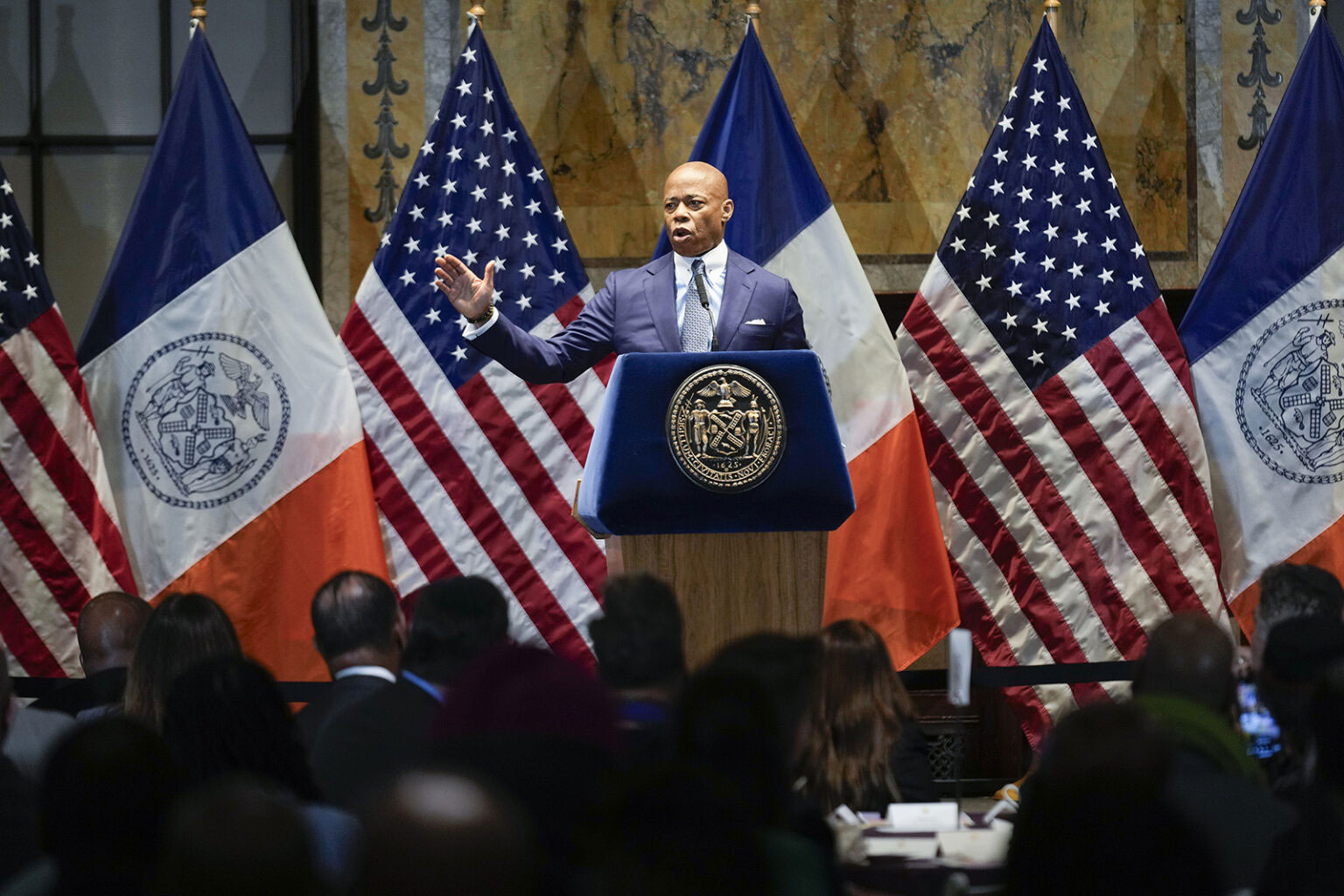
New York City Mayor Eric Adams speaks during an interfaith breakfast event in New York, Jan. 30, 2025. (AP Photo/Seth Wenig)
“He started the Friday Muslim prayer in the City Hall,” Shahidullah said, in reference to Adams’ office embrace of the adhan, or the Muslim call to prayer, across the city. “This was the first time in history that we were given permission, under his leadership. Also, the halal food is provided in public schools. This process started a long time ago, but in this term, they actually executed it,” Shahidullah said.
In December 2022, Adams formally expanded halal food access in schools citywide as part of his “Cafeteria Enhancement Experience” initiative. The faith-based shelter program has since paused, Monrose said, as the flow of new migrants slowed.
Since last winter, Adams’ rhetoric on immigration has become more critical, increasingly aligning with President Donald Trump’s hard-line anti-immigration stance. Some New Yorkers questioned whether Adams’ alignment with Trump’s policies was an attempt to secure a pardon on his federal corruption charges — charges that were ultimately dismissed after the Trump administration pressured the Justice Department. Adams has denied any connection between his policy positions and the case’s outcome.
“I do wish Mayor Adams had been able to stand up more strongly to the Trump administration on these issues,” Gudaitis said. “But it’s hard. I mean, could you imagine what New York City would be like if ICE was doing here, what they’re doing in D.C. and Chicago? I mean, it really worries me.”
While Adams’ evolving immigration stance divided voters, faith leaders say his legacy will be defined less by politics and more by partnership, especially his efforts to bring clergy into the city’s work on public safety.
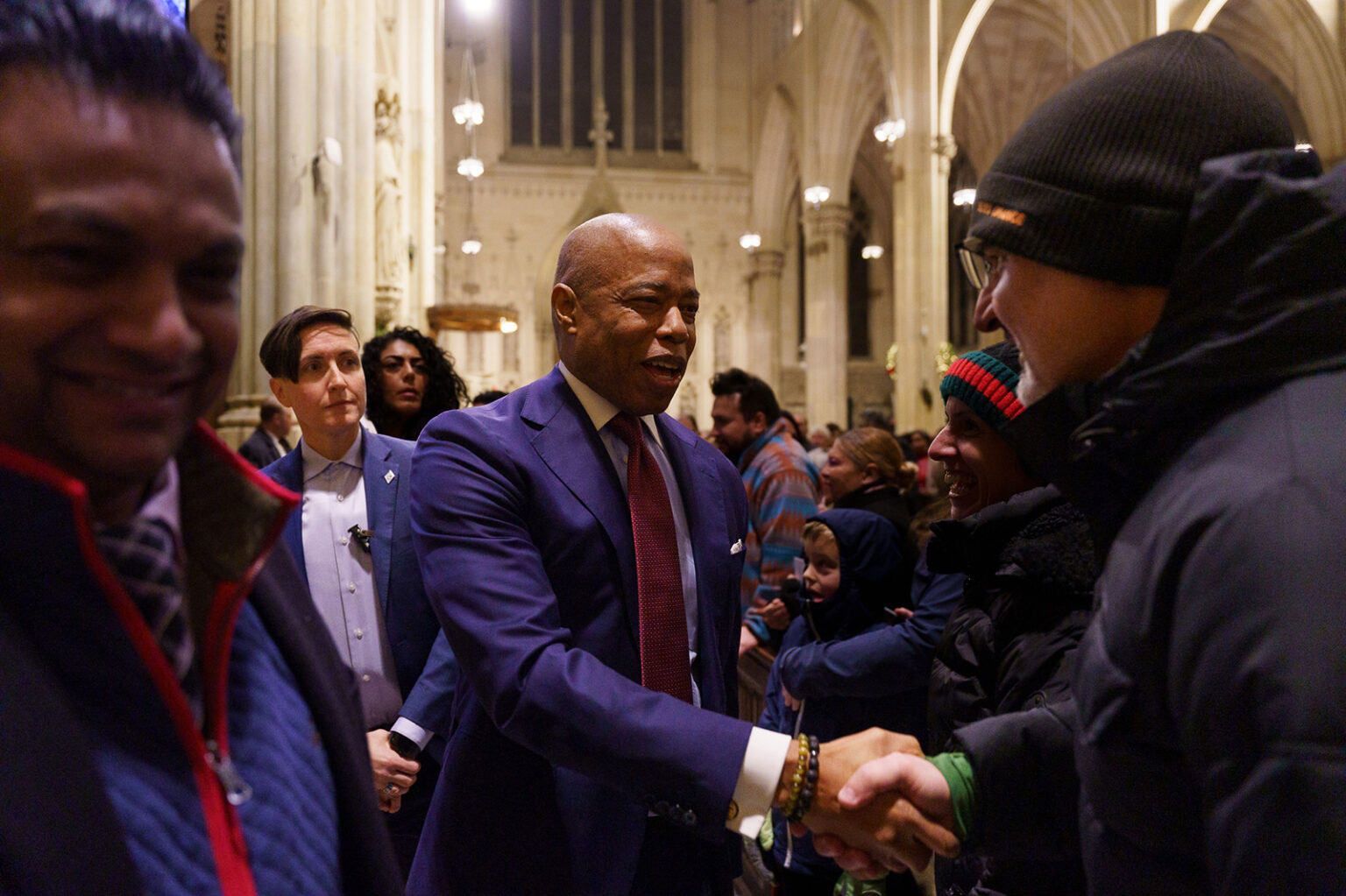
New York City Mayor Eric Adams, center, attends midnight Mass at St. Patrick’s Cathedral, Dec. 25, 2024, in the Manhattan borough of New York. (Photo courtesy of the Mayoral Photography Office)
One of the last major initiatives Adams will be remembered for is the Citywide Clergy Collective, launched in January 2024 with a $1.5 million city grant and agency partners including the New York Police Department. The program trains clergy to intervene after shootings, mediating tensions, supporting families and organizing funerals and vigils, while doing ongoing “triage” to prevent violent retaliation within communities.
Since joining the initiative, Bishop Chantel Wright, pastor of Reach Covenant Ministries International, a church-led community organization in Harlem, a neighborhood with one of the highest rates of gun violence in the city, her community has seen real change.
“What has happened for us is that there have been no killings,” she said. “Now, the older ladies in our community, they feel safe at night. They’re able to walk out and be in the community without ducking stray bullets.”
The last time her group assisted a family after a murder was last spring. Through the collective, Wright helped relocate the victim’s family, paying for transportation and funeral costs.
The collective’s model has since been adopted beyond New York. Monrose has held conferences about the program in Pittsburgh and helped establish an office of violence prevention in his hometown in the U.S. Virgin Islands. He has also trained pastors in St. Lucia and in Belize. In New York, the collective’s funding has covered meals for bereaved families and clergy-run after-school programs to keep youth engaged.
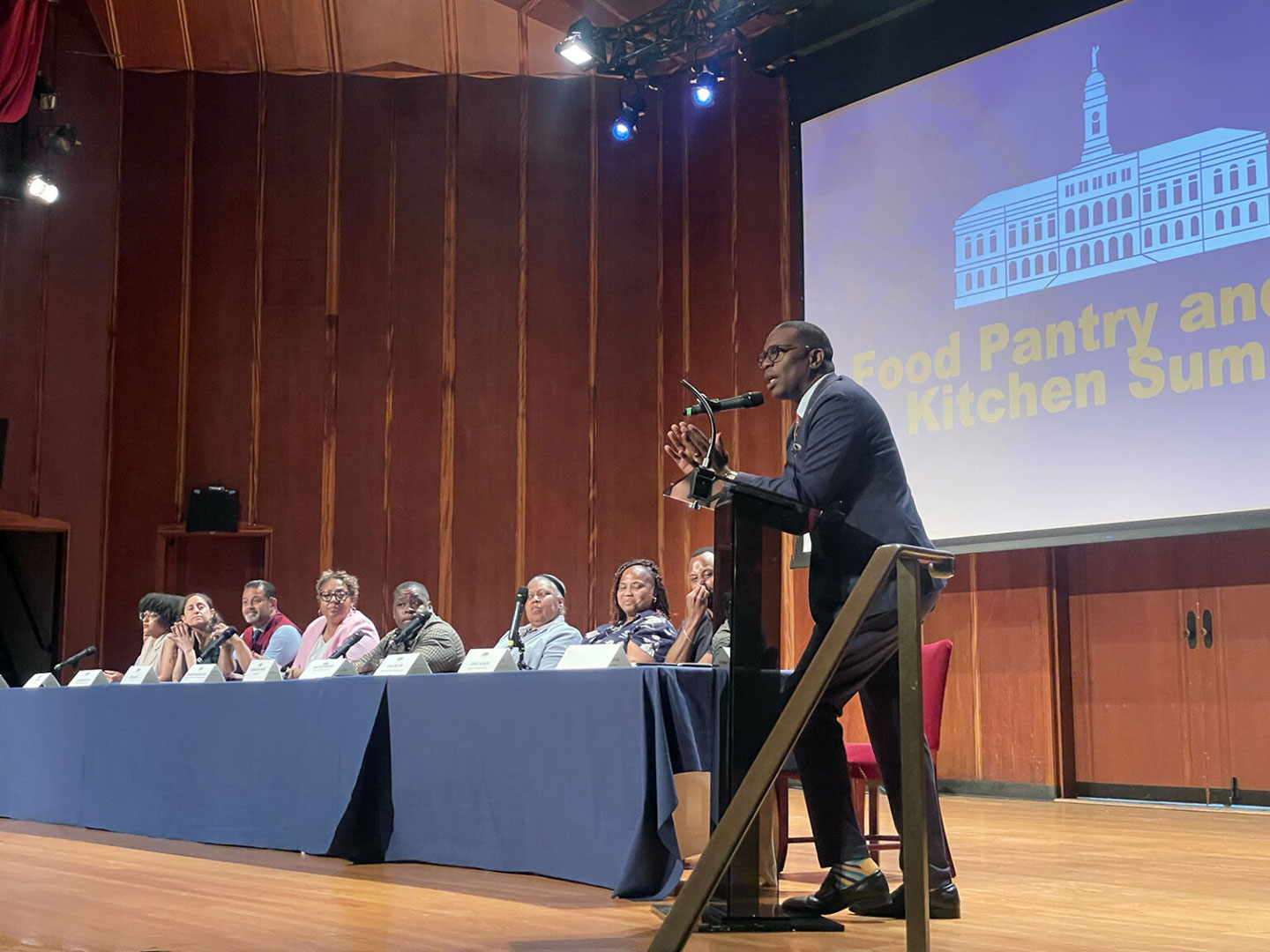
“I just pray that the seed has been placed in the ground through the faith-based community,” Wright said. “I pray that whoever comes into office has enough wisdom not to dismantle it. It’s their secret weapon.”
Looking ahead, Monrose said he sees Adams’ legacy with faith communities as just the beginning. “I have never read a good book with only one chapter,” Monrose said. “I’m glad that I have the opportunity to be able to be a trendsetter when it comes to how cities and government work with clergy.”
Some faith leaders remain uncertain about the next batch of candidates. “The current candidates, I don’t work with them,” said Michelle Davis Levy, who goes by Rev. Zoya, from the Illuminating Center of God in Brooklyn. “I haven’t seen them in my neighborhood, and that’s an important point for me, to be forward facing a candidate, to be forward facing with the community they’re going to serve.”
Mamdani, a progressive Muslim and current state assemblyman, and Cuomo, running as an independent, have begun courting faith leaders in different ways. On Oct. 1, Mamdani’s campaign announced it will be backed by Defend and Advance, a new Muslim American super PAC, which has launched a five-week effort to mobilize the city’s nearly 388,000 registered Muslim voters ahead of the election. The Mamdani and Cuomo campaigns did not respond to request for comment.
Still, some clergy say they remain hopeful that the network Adams built will outlast his time in office.
“We made this coalition of faith-based organizations and community organizations, and we’re in partnership, and I don’t believe that’s going to go away just because Adams is no longer going to be our mayor,” Davis said. “I believe that they will continue to prosper and bear good fruit, no matter what.”

 The New York Times Executive Chairman Anthony Pratt delivered the opening remarks at the recent New York Times Climate Summit.